
"Serious sport has nothing to do with fair play…it is war minus the shooting."
What Sport Tells Us About life
Return to the book list for titles beginning with 'w'.
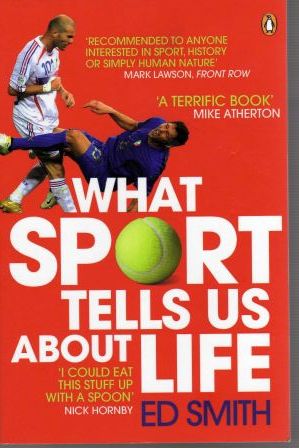
What Sport Tells Us About life, Ed Smith, Penguin, 2009 190 pages
A very thought-provoking book which looks at issues in sport.
Chapter 2 argues that professionals need an amateur outlook to survive. He quotes Felipe Scolari: 'My priority is to ensure that players feel more amateur than professional. Thirty to forty years ago, the effort was the other way. Now there is so much professionalism, we have to revert to urging players to like the game, love it, do it with joy.' (Page 19)
Chapter 3 deals with the nature of genius and madness
For me the most fascinating chapter was Number 10 "When is cheating really cheating?" which examines how some – clear and blatant - breaches of the laws of the game are acceptable while others are not – eg in cricket it OK not to 'walk' but is considered cheating to claim a catch you have not caught.
"When is getting away with it acceptable? And when is cheating really cheating? It isn’t as simple as it sounds. There is a rule book as it is written, a rule book as it is played, and a rule book as it is watched and absorbed in the stands". (Page 12)
And
"Attitudes to cheating change imperceptibly. The professional foul is another example. It has always been a feature of sports such as basketball, where each player has quota of five fouls he is 'allowed' to commit before being 'fouled out'. It is considered perfectly acceptable and right to grab hold of an opponent who is about to make a certain score". (Page 124)
P125 – two rugby situations. Killing ball is acceptable. Blocking run is not.
As a former professional cricketer, his take on ball-tampering is fascinating as his is interpretation of the Darrell Hair/England/Pakistan confrontation. Using the analogy of speeding being an acceptable crime but drink-driving being unacceptable, he comments:
"Hair thought he was dishing out a speeding tick. Pakistan felt they were in the dock for drink driving. It was an argument about our attitudes towards the crime as much as whether the offence had happened in the first place. It was a disagreement about conventions and conventions are always in a state of flux. Perhaps, in the heat of the moment, we could have reminded ourselves about that". (Page 129)