
"It matters a great deal who is going to win, but not at all who won"
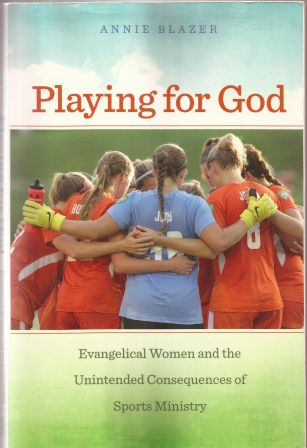
Playing for God
Return to the book list for titles beginning with 'P'.
Annie Blazer, NEW YORK UNIVERSITY PRESS, 2015. ISBN 978-1-4798-1813-6
Annie Blazer is a “white, female non-athlete and an atheist scholar (anthropologist)” who studied evangelical women who are athletes. The book’s sub-title is “Evangelical women and the unintended consequences of Sports ministry”. She travelled with an AIA women’s basketball team and with the Charlotte Lady Eagles soccer team as well as attending various FCA and AIA events and talking to organizational leaders. She quotes extensively from women involved in the various teams and activities. While not sharing their presuppositions, she clearly has a deep understanding of evangelical Christianity. Equally I never felt that she had misrepresented the athletes quoted; their comments had a real ring of truth to them.
My main criticism of her presentation of evangelical theology of sport is that she has massively overestimated the importance of Wes Neal’s contribution. I suspect that few contemporary sports ministry people have read or been influenced by his writings.
The material in the book is arranged in six chapters plus introduction and conclusion. The six chapters cover (my summary)
Conversion and witnessing;
The embodied pleasures of sport;
Spiritual Warfare and Christlikeness;
Evangelical femininity;
Sexual desire and deviance;
Faith off the field.
This book argues that evangelical engagement with sport has had some unexpected effects and consequences for evangelical women athletes, arguably causing them to rethink their gender understandings. Perhaps the strongest message in the book is the belief that for most Christian athletes there is a constant struggle to unite two identities: Christian and athlete. My review will look at the implications of this dichotomy for witness, winning, perceptions of femininity and lesbianism.
Witness
The book argues that sports ministry organizations are moving away from the original concept of sport as a tool to evangelise towards pleasing God in and through sport. Players see their ability as a gift from God and derive pleasure from playing sport. Witness is still there but often described as “witness without words” – ie witness through playing in a Christlike way which goes against the norms of the world of sport. Experience has suggested that this is a more effective method of witness than preaching at half-time. Moreover, the author asserts: “The athletes in this book used their bodies, not their words, as the primary element of their Christian identity”.
Incidentally there is some interesting discussion of what this means: for example, should a Christian team try to keep the ball at the corner-flag to run down the clock?
Winning
The book reflects on what is sometimes called “the problem of winning.” That is, in order for Christian athletes to attract an audience to listen to their message of salvation, the athletes have to win; the losing team is much less likely to draw an audience. But the need to win may require them to compromise some Christian principles or as the author puts it “how to reconcile the need to win with the need to demonstrate on-field sportsmanship and compassion”.
Part of the solution was to change the definition of winning in the direction of performance, effort and behaviour rather than the simple result of the contest. A different motivation for winning came from one of the Charlotte Lady Eagles who said: “Part of playing for God is playing to win” implying that winning was important because it demonstrated to others that Christianity does not diminish one’s athletic ability or competitiveness.
Femininity
The issue is well summed up in this quotation from a soccer player. “I mean, I’m six foot two. I’m tall and strong. I’m the loudest, meanest player on the field. And that’s just not allowed for women in the church. It’s just not allowed”. While the evangelical world might be said to expect women to wear pink dresses, jewellery and put ribbons in their hair with the aim of getting married and having children, many sporty women aspire more towards reaching elite level in their sport and consequently feel more comfortable in shorts or tracksuits. Some athletes made a point of choosing particular types of clothing, makeup, jewellery, and hairstyles to express traditional femininity when they were away from the sporting environment.
The book argues that women athletes struggle to reconcile the expectations of the three settings in which they move: the conservative Christian church community, sports ministry communities and secular sports teams. In some cases involvement in a Christian sports organization was a way to bridge the gap and make an athlete feel “a sense of belonging to evangelicalism without modifying her appearance or sacrificing her goals”.
While men who play sports tend to confirm gender expectations by demonstrating masculine traits—such as strength, precedence, agency and leadership, women in sport who demonstrate these same traits are challenging the idea that masculinity belongs solely to men and that femininity goes beyond the traditional feminine virtues of nurturing,yielding,responsive,receptive etc.
The book also acknowledges that for women who desire to play sport at the elite level achieving and sustaining a godly marriage can be difficult to negotiate.
Lesbianism
The research showed that evangelical female athletes had more difficulty reconciling traditional evangelical views of lesbianism with their experience and were likely to be more sympathetic to lesbians than other evangelical women. The book quotes several women who either struggled personally with the issue or with the application of the traditional evangelical view within their ministry.
As one soccer player put it: “I don’t know what the answer is. I don’t think we serve a God who could be that cruel, to make someone that way and then tell them that it is wrong. I don’t know if God sends gay people to hell. I wrestle with that all the time. It’s hard for me”. The spectrum of views on the issue went from trying to “pray the gay out”, to seeing it as a sin but no more so than pride, to regarding it as a grey area.
Overall I found this an excellent book which raises important issues about how contemporary sportswomen perceive themselves.