
"Lord, I don't ask that I should win, but please, please don't let me finish behind Akabusi."
Ethics in Sport
Return to the book list for titles beginning with 'e'.
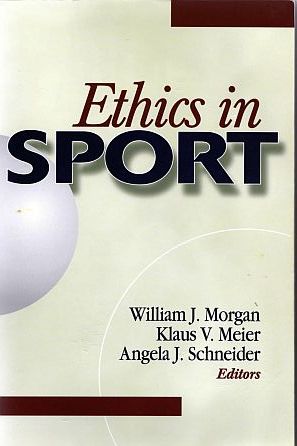
Ethics in Sport, William J Morgan, Klaus V Meier, Angela J Schneider (Editors). Human Kinetics 2001 ISBN 0-7360-3643-1 (426 pages)
The book contains 29 chapters by different authors, arranged in 5 sections
Fair play, being a good sport, cheating Performance enhancing drugs
Women in sport
Animals and their use in sport
The social ethics of sport
The book addresses three basic questions:
How should human agents treat one another in sport settings?
How should they comport themselves individually and collectively in the pursuit of athletic excellence?
How can of sport be morally evaluated from the larger standpoint of society? (Page ix)
I found the chapters on fair-play of particular interest. Six ways to look at fair play are suggested
Fair play as a bag of virtues
Fair play as play
Sport as contest: Fair play as fair contest
Fair play as respect for rules
Fair play as contract or agreement
Fair play as respect for the game
A definition is suggested: "The good sport is gracious in both victory and defeat because he or she recognizes that opponents share the values and spirit of sport" Page 3
"The strange paradox of sportsmanship as applied to athletics [sport], is that it asks the athlete, locked in a deadly serious and emotionally charged situation, to act as if he were engaged in some pleasant diversion". James Keating, Page 16
"For the athlete, a competition is a chance to show and test his or her skills, to play the best game that he or she is capable of. In this case, the interests of the athlete are in producing the best possible game." Robert Butcher and Angela Schneider (Page 39)
Chapter 3 "on winning and athletic superiority" by Nicholas Dixon discusses among other what happens when the better side does not win. Dixon uses the phrase "failed athletic contests".
Factors contributing to "failed athletic contests" include (Page 50ff)
Refereeing errors Cheating
Gamesmanship (including professional fouls)
Bad luck
Inferior performances by superior athletes
In Chapter 4, some reflections on success and failure in competitive athletics, Edwin J Delattre suggests competition is "a form of self-discovery" (Page 74) He quotes the sportsmanship of Bobby Jones. OB Keeler that was interviewing Bobby Jones and are to Bobby Jones calling penalty strokes on himself, possibly costing himself opponent "Bobby held up a warning hand, 'that is absolutely nothing to talk about and you are not going to write about it. There is only one way to play this game.'" Page 75 "Bobby Jones on golf style from "The omnibus of Sport", Grantland Rice and Harland Powel (eds) Harper and Brothers, NY 1932
Cheating and Fair play in Sport by Oliver Leaman is very provocative. He starts by arguing that is not as easy as we might think to define cheating or to say why it is wrong.
For anyone who is interested in the ethics of sport, this is a must-read book.
Incidentally on page 28, Robert Butcher and Angela Schneider refer to bobsledder Carlo Monti in 1952 giving his brake to an opponent. It was actually Eugenio Monte at the 1964 Olympics and it was an axle bolt!