
“All I know most surely about morality and obligation I owe to football”,
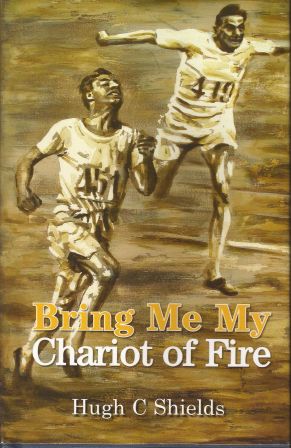
Bring me my chariot of fire
Return to the book list for titles beginning with 'b'.
Hugh C Shields, Grosvenor House Publishing, 2017. ISBN 978-1-78623-842-9
I have 11 Eric Liddell books on my shelf but the latest one is very welcome and told me things I did not know. I agreed with the comment in the introduction: “It is impossible to write about him, still less understand him, without an appreciation of his deep religious conviction”, particularly as I wrote in my review of Duncan Hamilton’s otherwise excellent book, that I felt he did not understand the importance of Liddell’s Christian faith.
I liked the build-up to the 1924 Olympic final, with an account of Liddell being beaten in 100 and 220 races in the USA in April 1924 and the suggestion that these defeats gave Liddell a sense of realism about his place in the world pecking order. In fact, the author suggests that only after running 48.2 in the Olympic semi-final, did Liddell seem a credible contender for the medals. There is also some good information about Liddell’s running in China 1926-30
A strength of the book is the contrast between Eric Liddell and Harold Abrahams. One chapter is devoted entirely to Abrahams. Writing of Abrahams, the author comments: “The contrast with Eric could not have been greater. Eric ran in God’s name and with God’s will. There was nothing to worry about for the outcome was always simply of God’s making. Should he not win this was God’s wish and there would be another race on another day. But for Harold - and despite his Jewish religious upbringing - racing was a much more intense and personal affair”.
The comparison between the two comes out in the following two comments: “The men’s 100 metres final was scheduled for 7:05 PM and this was Harold s appointment with destiny. If he won he could draw on this supreme achievement for the rest of his life. But if he lost, he would forever live in the shadow of defeat” and
“But the key to understanding Eric’s greatness as an athlete lies not in matters of running style. It was his closeness to God which defined him. Eric ran not for individual glory or even of his country. He ran as an expression of his love of and belief in God” but Eric certainly also wanted to win.
I was really interested in two reflections by Abrahams about Liddell – one about whether Liddell would have been better runner with a better technique or if trying to change him would have ruined his natural talent and a reflection on what would have happened had Liddell faced Abrahams in the Olympic final.
Overall an excellent contribution to our understanding of Eric Liddell.